When a template builder stops being the cheap option
Two clients left Wix this year for opposite reasons. Neither was wrong to start there. Both had quietly been paying for it long after it stopped being the sensible choice.
Camp Beer Co.’s website does more than it ever has. A live taproom menu, a TV tap board that updates itself, a share poster for every beer. It also costs less each month than the Wix plan it replaced.
That last part surprises people, because the story they’ve been told runs the other way. Template builders are the cheap option. Custom is what you do when you’ve got money to burn. For a long time that was true, and for plenty of businesses it still is.
So, fairly: a template builder is a good tool. You can have something presentable by Friday without hiring anyone. If you run a small shop, your site is a few pages that rarely change, and you enjoy editing it, stay where you are. I’d tell you that on a call.
The trouble is that nobody notices the day it stops being the right tool. There’s no invoice for it. It just gets slowly more expensive in ways that don’t show up on the plan.
I’ve moved two businesses off Wix this year, and they hit the wall from opposite sides.
Camp hit fragility. Here’s the editor behind their old menu:
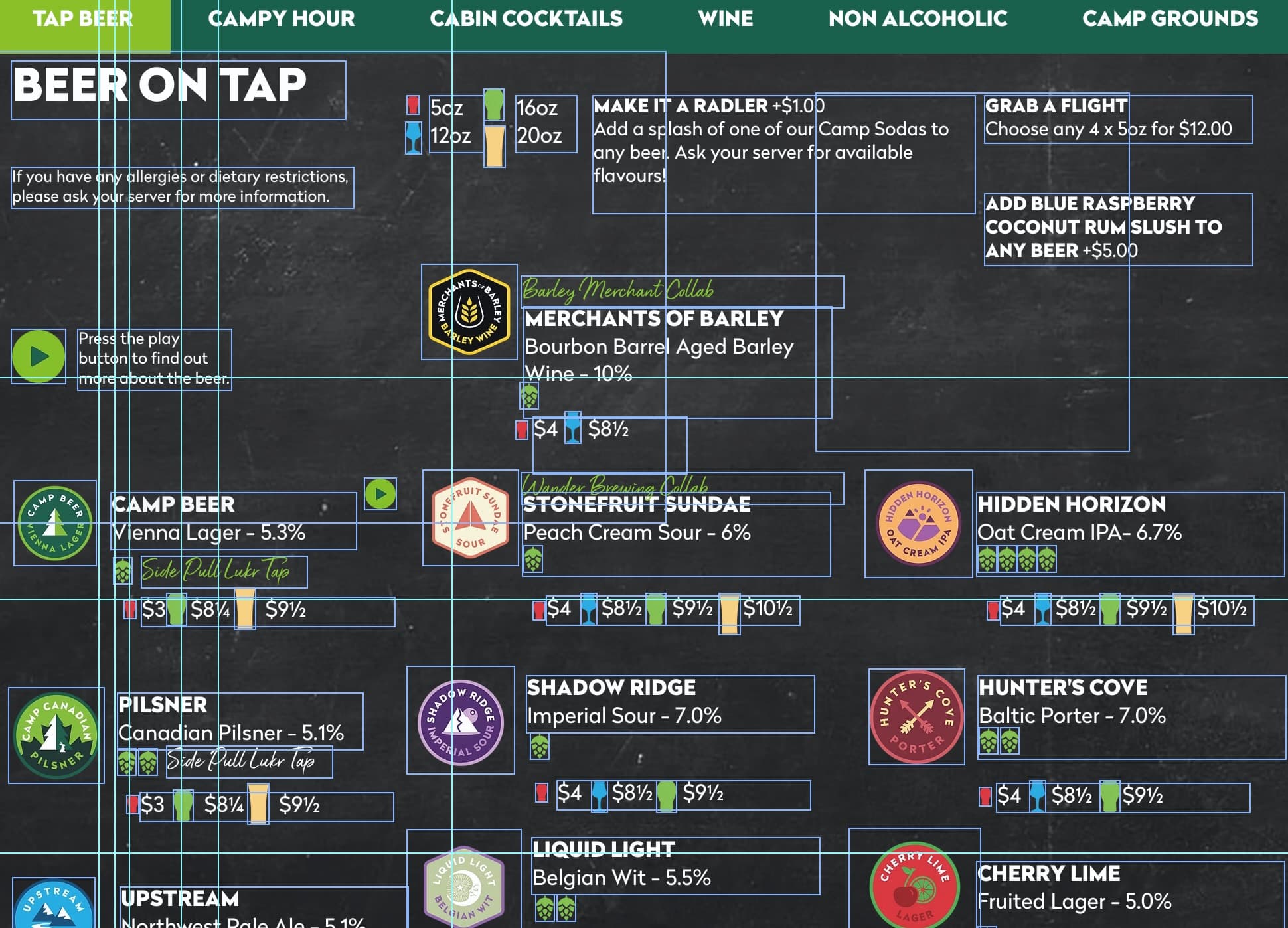
Every outline is a separate text box, placed by hand. Changing one price meant nudging a box and hoping nothing else moved. So the team did the sensible thing and stopped touching it. The real menu lived in InDesign and went out as a PDF every time a keg blew. The subscription was cheap. The hours every week weren’t.
Serif + Gold hit the ceiling. Aaron is a professional designer. He could drive Wix better than most people who build on it, so editing was never his problem. His problem was that everything he made had to fit inside what the theme could express. His new identity didn’t: navigation in four corners, a licensed typeface, a colour world for every project. None of that is a widget. The site he had was tidy and said nothing about the studio behind it, which is a costly thing for a design business to show a prospect.
Two different walls, one shared symptom. Both businesses were paying a monthly fee for software they’d learned to work around.
The subscription is the cheap part. The workarounds are the bill.
What changed isn’t that template builders got worse. It’s that the two old reasons to avoid custom mostly went away.
The first was the build cost. It still costs money up front, and I won’t pretend otherwise. But one person building on plain, widely used tools can deliver in weeks what used to need an agency and a quarter. Most of each budget goes on the parts a customer touches, not the plumbing.
The second was dependence. Custom used to mean emailing a developer for every change. Now the content lives in a CMS the staff run themselves, set up so no field can break the design. Camp’s team publishes a beer and it’s on every screen within minutes. Aaron has published fifteen case studies without me.
And the running costs are for hosting and a CMS, on the client’s own accounts. You stop paying for permission to edit. That’s how Camp’s bill went down while the site grew.
If you’re wondering which side of the line you’re on, here’s the test. It’s worth more than any feature comparison.
STAY ON THE TEMPLATE IF        IT'S TIME TO LEAVE IF

a few pages, rarely change     parts of it you've stopped touching
you enjoy editing it           the real version lives somewhere else
it says what you do            you pay for add-ons to fake a feature
nobody works around it         it looks like everyone else's
One tick on the right is normal. Two or more, and you’re already paying for custom. You’re just paying in hours instead of on an invoice.
Both rebuilds, before and after, are on the work page.
Working on something like this? hey@samjennings.dev